Microtunnels #
I'm a big fan of tunnels. I've previously blogged about tunnels for package delivery and tunnels for infrastructure like electricity, internet, water, etc. But I think tunnels might also be useful at a very small scale, within my yard. If we had flexible tunnel boring machines that could dig 4mm diameter tunnels:
- For each plant with invasive root systems (bamboo, blackberry) I'd tell the machine to follow the roots and set fire to them 🔥
- For each tree I'd tell the machine to follow the roots and deliver nutrients and dislodge pests 🐛
- For drough prone areas I'd tell the machine to dig a network of tunnels that could absorb precious rainwater into the ground so that it doesn't run off 🏜
I expect the small diameter tunnels would be much easier to dig but at the same time the flexible paths would be harder to build robots for.
[Terminology note: microtunneling already refers to 40mm tunnels much larger than these, and nanotunneling already refers to 40nm tunnels much smaller than these, but micro seems like a closer match]
Labels: future
Fractal islands in the Pacific #
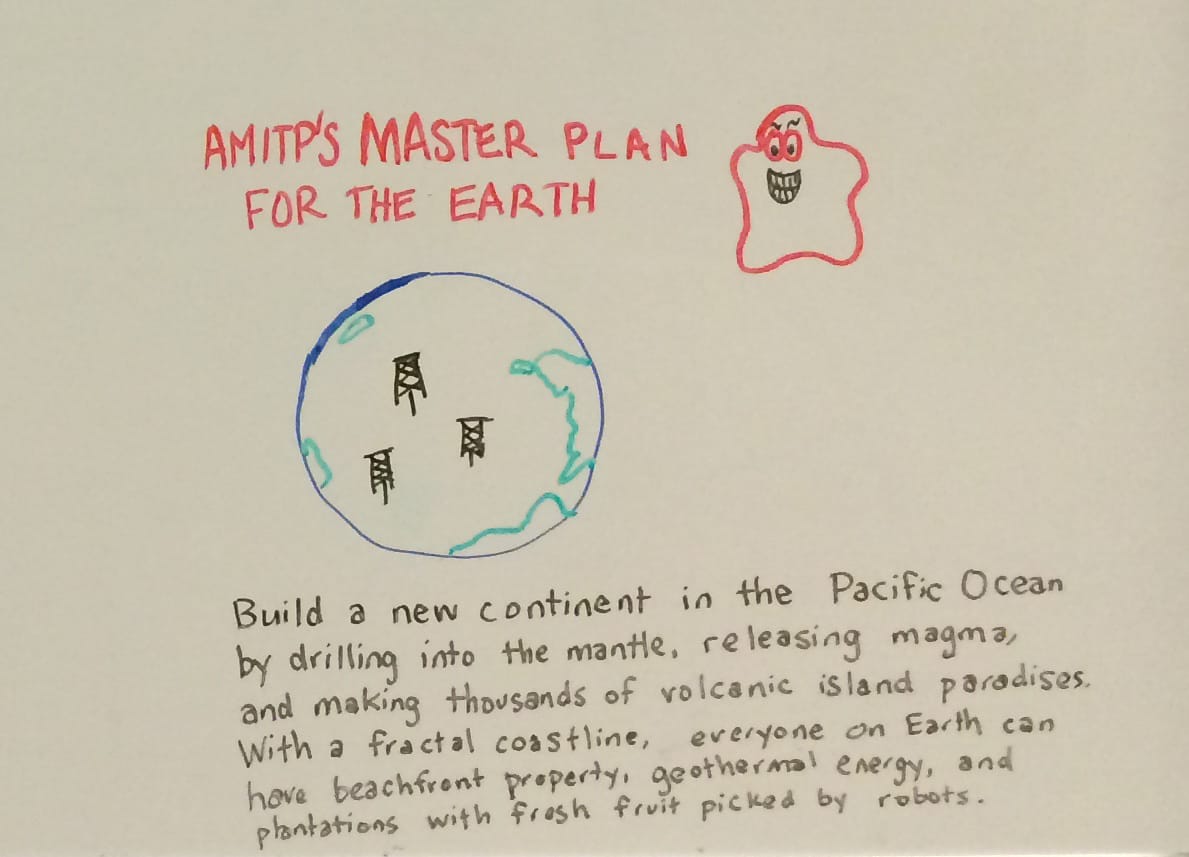
I'm not a big fan of the Pacific Ocean. There. I said it. I like water/land interfaces. Coasts, rivers, lakeshores, beaches, coral reefs, tide pools. The Pacific Ocean has too few of these. So … let's fix it. Here's an idea I had from around 2003 but never blogged about:
Labels: future
Tunnels everywhere #
Right now tunnel boring machines are expensive and we only use them for a few projects. If they were cheaper we'd have a lot more of them and use them for many more roads.
I've long wanted tunnels for lightweight freight transportation (see my blog post from 2005) but I'd also like tunnels for infrastructure in general — electricity, gas, water, gray water, cable tv, telephone land line, fiber optic internet, mail delivery, trash collection, etc. It's a shame that we have to dig up roads to install or fix any of these. It's a shame that I can't get gray water for my yard and am using drinking water to water my flowers. It's a shame that fiber optic internet access is so expensive to install. It's a shame that we have to see ugly power/telephone/cable lines everywhere. Also, a lot of this stuff would be better out of the weather.
Cheap tunnels would change a lot of things! I'm hoping Elon Musk will make this happen!
Labels: future
Custom fortune cookies #
Idea: when at at Chinese restaurant, use facial recognition and/or tap into vast databases of personal information linked to your credit card to gather lots of information about the people at the table, then use deep neural networks to write a custom fortune for each person, then use focused microwaves to print these on blank pieces of heat-sensitive paper embedded inside fortune cookies. Then when you get your fortune cookie, it'll be personalized just for you. Maybe it could be a targeted ad!
Labels: future
Flying drone mesh network #
Photo: xdamman on flickr
We don't collect enough weather data from the atmosphere (or ocean). We also would like internet service everywhere on the planet. Let's solve both problems at once:
A 3D grid of tiny flying drones that collect temperature, humidity, wind from every location and elevation, and also serve as a mesh network ISP that provide internet access to everywhere on the planet.
Ok, maybe it wouldn't really work. Oh well.
Labels: future
Bluetooth tooth #
People sometimes get tooth implants to replace missing or decayed teeth. Currently they're milled or 3d printed. But I think we could do much more. Why not put bluetooth into your tooth? We'd get:
- Speaker so that you could listen to tunes streamed from your phone.
- Microphone attached to the bone so that you could make phone calls without nearby people overhearing what you say.
- Sensors to measure and report the status of your mouth. Real time graphs of saliva, food, and dental bacteria can be sent to your phone, like a Fitbit for your mouth.
It'll finally turn the "tooth fillings pick up radio signals" myth into reality. Would you get one? I would!
[Update 2025-02-03] Found this announcement from 2008
Labels: future
Scented sweat #
Many or perhaps all of the smells produced by your body are produced by the bacterial ecosystems living on and in you. Some of these smells are things we can detect; others we're unaware of. Certain strains of skin bacteria attract mosquitos. By altering the ecosystem on our skin, we can repel mosquitos. Cool!
With genetic engineering, we can do even more. We can replace the bacteria that turn sweat into unpleasant smells with bacteria that turn sweat into floral scents! No more deodorant!
Labels: future, speculation
Future tattoos #
Today's tattoos are boring. Future tech will bring:
- Bioluminescent tattoos: using bioluminescent chemicals, your tattoos will glow or pulse, either all the time, or synchronized with a clock, or triggered by movement or light or sound. Imagine going to a dance club with this.
- E-ink tattoos: with e-ink particles embedded in your skin, you'll be able to change the pattern by applying an external array of electric fields. You'll place the “printer” on your arm, apply a new pattern, and then it'll hold that pattern until you want to change it.
- Biosensor tattoos: with e-ink particles attached to a layer of biosensor molecules, you'll be able to find out what's going on in your blood. You'll set up blocks that are sensitive to 50, 100, 150, 200 mg/dL of glucose, and then by seeing how many bars are “lit up”, you'll have a rough estimate of your blood sugar. You could do this for everything in your bloodstream.
Cool? or creepy?
Labels: future, speculation
Bladder control #
I know there are lots of advanced technologies being developed for treating disease, but the same technologies could be used for non-disease applications. I wrote a little about this a few years ago. So I want to propose something that I think a lot of people would like:
Extra bladders
There are people working on 3d printed organs. Wouldn't it be cool to get a 3d printed bladder? Would you like to super-size that?
Even better, wouldn't it be cool if your supplemental bladder automatically ran tests on your urine, like these Japanese toilets do? The toilets developed in 2004 can measure glucose levels but I'm sure there are other tests that will be practical too. Plus, if it's done in your 3d printed bladder, it can be transmitted to your smartphone in real time over low energy bluetooth, like a Fitbit.
I'd want one. Wouldn't you?
Labels: future, speculation
Genetically engineered gut bacteria #
We're starting to learn how important gut bacteria are. Antibiotics can mess up the ecosystem in your gut. We have probiotics to try to restore the natural ecosystem.
(photo from worldworldworld on flickr)

This is assuming that natural is good. But the natural gut bacteria are evolved to match our natural diet. Most of us don't eat a natural diet.
I want unnatural gut bacteria.
We know cells can do amazing things. The cells in our body can turn fat and sugar into energy. Bacterial cells can do a far great variety of things, such as turning algae into oil, collecting gold atoms into gold veins, generate light, and process heavy metals. So let's design our own gut bacteria! I want to implant gut bacteria that turn chocolate cake into vitamins. I want gut bacteria to turn potato chips into omega 3.
Most people are drawn towards unhealthy food. We keep telling them to stop eating it, and eat healthy food instead. What if we could instead turn all unhealthy food into healthy food? (Also see my previous post on this subject.) I think that's a world-changing technology waiting to happen.
Update: [2024-03-22] Over ten years after I posted this, I see Monch Monch and Zya look interesting. They aren't gut bacteria but they do go into the gut to turn chocolate cake into fiber. Update [2025-04-14] Jason C points out that proteins require nitrogen, and carbs don't have any. So there could be some limitations to which molecules can be turned into which other molecules. Fiber may be a better output than protein. [2025-12-07] Someone has developed a genetically engineered gut bacteria to reduce kidney stones.
Labels: future, health, speculation
Gene therapy #
In an alternative universe, instead of hearing about gene therapy for:
- Cancer
- Alzheimer's
- Parkinson's
we'd be hearing about gene therapy for:
- Hair loss
- Hair color
- Hair style
- Eye color
- Skin color
- Perfume
- Effects of aging
- Weight loss and gain
- Muscle growth
- Body part enhancement
- Chicken that tastes like bacon
For the yellow outfit you're wearing today you might pick a light brown skin tone and green eyes. You'd use the light brown skin tone body wash to change the genes in your skin. You'd put in the green eye eyedrops to deliver the genes into your eyes. You'd place a stencil on your skin and use a spray to deliver genes for a light skin color tone to form a tattoo. You'd deliver citrusy scent genes to the odor-creating bacteria on your skin to produce that smell today.
But we don't live in that alternate universe. Instead of all these miracles, all we're going to get is a cure for cancer.
Labels: future, speculation
Future anti-predictions 2 #
I'm quite optimistic about the future, but I seem to be posting anti-predictions instead of predictions. Perhaps I'll post positive predictions someday, but today I have some more negative ones:
Labels: future, speculation
We need infinite energy #
[Warning: my thoughts on this topic are still not entirely clear. I sat on this post for a week but I couldn't find better words, so I decided to post anyway.]
When I think about being “green”, I think of three things:
- Clean: solar, wind, wave energy instead of coal, oil, and sometimes nuclear. Part of this is to reduce pollution, but lately it's about reducing CO2 released into the atmosphere.
- Sustainability: renewable energy, better agricultural practices, and sometimes population reduction/stability. This is to avoid depleting resources.
- Conservation (mostly of energy): less driving, less air travel, less lighting, less water, less energy. This is to reduce the impact of our activities on the planet.
I think all of these could use refinement.
I'm a big fan of Clean. Pollution in general is getting too little attention these days, and CO2 gets too much. CO2 is not a poison; it's a good gas to have. Our problem is that we're way out of balance. We're producing far more than we use, so it's building up in the atmosphere. We need to get back into balance, but that doesn't mean zero. Pollution on the other hand we should be at zero. But it doesn't need to be zero production; it's okay to produce if you can clean it up. For example, algae, fungi, and bacteria can be used to clean up some types of pollution, and titanium dioxide can do wonders. Here again balance is the key. Produce as much as is used, and we're good. That's different from saying produce zero.
I'm a fan of Sustainability but I think it's secondary to, and a consequence of, balance. I think depleting non-renewable resources is fine, as long as we do it knowing we're using it up, and we start coming up with a sustainable solution. We might decide to use oil, but deciding not to use it because we're going to use it up is not a compelling reason. Not having any oil and not using any oil are essentially the same. I think for now we should continue using oil, especially for waxes, lubricants, and biodegradable plastics.
I'm less of a fan of energy Conservation, in part because I think it addresses the wrong issue. (Raw material conservation is a separate issue.) The problem isn't turning the lights on. The problem is the impact that causes, because the electricity is generated in ways that pollute or produce CO2. Do you turn off your solar-powered yard lights when you don't need them? Doesn't it sound silly? Turning off your incandescent bulb powered by a wind farm seems almost as silly. Solar, wind, and wave energy are abundant—in fact, literally tons of photons fall on the Earth every hour. And if we don't use that energy, it's lost. If we had abundant clean, cheap energy, would we still feel bad about using incandescent lights? I think we would, because we're trained to, but we shouldn't. There are still good reasons to use less energy, but they're about cost rather than environment.
Historically, asking people to switch to a worse lifestyle at lower cost (public transit in suburbs, abstaining from sex, eating boring food, not going on vacations, using unpleasant lighting, etc.) doesn't seem to be as effective as asking people to switch to a better lifestyle at higher cost. The EV1 and original Insight were “sacrifice” cars. You had to give something up (range, comfort, size), but you could feel good about sacrificing for the sake of the environment. The Prius is quite different. It is comfortable, is roomy, has nice features, and has good range. You're not sacrificing lifestyle when going from a $16k car to a $20k Prius, but it does cost more. And the Prius is far more successful than the EV1 or original Insight. We should focus on abdundant clean, somewhat sustainable energy. I think we'll improve the environment much quicker by giving people lots of clean energy than to tell them to sacrifice. In addition, lots of other problems, like cleaning water and reducing pollution, become much easier to solve when we have lots of energy.
[2019] The Tesla is an even better example of "don't have to give up anything" car than the Prius.
Labels: environment, future
Future anti-predictions #
Perhaps I'm just tired of waiting for my flying car or hoverboard, but I'm not so optimistic that we'll see certain technologies become popular.
- Cars that drive themselves. There's lots of research and good arguments about safety and efficiency and congestion. There are already commercial products for parallel parking, distance-controlled cruise control, and lane detection. But I think the real problem is liability. If there's an accident with a car you drive, it's a local problem (you). If a big company's car crashes while driving automatically, there's the potential for a very large lawsuit. Society benefits from automated driving but these companies pay for it. Early adopter individuals don't benefit enough that the companies can charge more. Such an arrangement makes it much less likely that these systems will leave the research phase. I also think congestion is much more likely to be addressed by variable pricing and better information than by automated driving.
- 3D displays. There's been a recent increase in 3D TV, movies, and video games, but most of the technology doesn't seem any better than the last time 3D flared up in popularity. The image in your eye is inherently 2 dimensional. If it were 3 dimensional you'd be able to see behind and inside things (Flatland is an interesting read if you want to understand this better). To see 3D in your brain you need to have separate images in the left and right eye. You can do this with glasses: color filters (red/blue, used for TV), circular polarized light filters (used in movie theaters), or timed shutters (used in video games). Or you can do this without glasses, by using the difference in viewing angle between the eyes (Philips WowVX for example), but this requires either a single viewer or all viewers to be roughly the same distance from the display. You can also produce 3D effects at a different level of the brain, by viewing different angles (either statically with animation or dynamically with head tracking). The problem is that all of these systems have limitations that exceed the marginal benefit of 3D, once the novelty wears off. So they'll all be used in specialized situations like medical imagery, advertising in malls, and a small number of TV/movie/game applications. But I think 3D displays are not going to be widespread.
- Humanoid robots. Humans are better than computers at some things: creativity, language, pattern recognition, art, design, reasoning. Computers are better than humans at some things: calculations, memorization, repetitive motion, fast sensors. People seem to think that the future is about making robots that look and work like us, but there's no point. We have plenty of humans. We will build robots that do the things we're not good at. And that means there's no particular reason to use a humanoid form. The future of robots is not humanoid. I think humans with machine parts will become commonplace, but they won't be robots replacing or competing with us; they'll be enhancing us.
In general though I'm quite optimistic about the future. I just think the things that actually succeed won't be the commonplace predictions you see in movies and TV.
Labels: future, speculation
Setting the Carbon Tax #
The carbon tax is a tax on CO2 emissions. It aligns incentives of business (profit) and society (stable climate) by giving businesses an opportunity to make more money if they find ways to reduce their CO2 emissions.
One open question with the carbon tax is how to choose the tax rate. Several countries already have a carbon tax, but they seem to set it at a fixed rate, or increase it by a fixed amount each year. Even the Carbon Tax Center says, “There is no magic formula or right number”. I think they're approaching it wrong. Carbon taxes are essentially prices on carbon emissions. Governments shouldn't set prices, and they shouldn't set carbon tax rates either. The market should do it, with a little help from the government.
First, we should decide what level of CO2 emissions are “sustainable”. You can think of this as the “supply” of available emissions. There is no need to go below this level, although doing so will not be harmful. We should be able to continue emitting at the sustainable level for thousands of years. This level is then set as the eventual sustainable target.
Our current emissions are rather high. We can think of this as “demand”. Since demand is higher than supply, we need to raise prices (the carbon tax rate, currently 0% in the U.S.). We need to decide when we want to reach the sustainable level, and then interpolate target levels from the current level to the sustainable target. This might be a straight line for simplicity, but could also be an S-curve or exponential decay.
For example, let's say that the current CO2 emissions are 6 billion metric tons, and we decide that 1 billion metric tons, combined with more forests, is sustainable. Let's further suppose that we want to reach this target in 10 years. That means we need to reduce emissions by 0.5 billion metric tons each year, so we set our target for 2009 to 5.5, 2010 to 5.0, 2011 to 4.5, etc., until 2018, at 1.0 billion metric tons.
Each year (or perhaps every month), we look at the current level of emissions and the target level, and increase or decrease the carbon tax rate. If we're emitting more than the target, we'll increase the tax rate. If we're emitting less (which may happen in a few years, if all the businesses are competing to increase profits by reducing emissions), then we decrease the tax rate. By altering the tax rate in this way, we can stay close to the target.
The problem on the business side is that if the tax rates change every month, there's a lot of uncertainty (just as for any prices that change suddenly every month), and it's hard to change plans that quickly. What will likely develop is an insurance market. Insurers will sell insurance that the tax rate won't go up much, and businesses will buy the insurance to hedge against sudden increases. Does this eliminate the incentives for businesses? No! They're now paying insurance and taxes. The cost of insurance is set by the likelihood at the tax rates will go up. The insurance industry is in the best position to guess this, because they'll be visiting the businesses to determine how quickly emission reductions are going into place. The insurance companies will then be able to predict the future emissions, and set insurance rates based on that. Since they're the ones making payouts when businesses (collectively) don't reduce emissions, the insurance companies will then have an incentive to push businesses to act sooner. They also have the incentive to share techniques across businesses. They make more money when businesses collectively reduce emissions.
Most carbon tax proposals use a fixed price and hope that the output will decline. Most cap-and-trade proposals use a hard limit on emissions, and a variable, potentially volatile price. The variable carbon tax rate proposal combines aspects of both approaches. It uses variable prices, but they're varying less often; it uses a target instead of a hard cap, which allows businesses to buy more time; and it generates revenue for society. With a market based scheme, incentive are aligned. Society will want reduced emissions, businesses will want to reduce tax rates (by reducing emissions), and insurance companies will want to reduce payouts (by convincing businesses to reduce emissions). If businesses fail to reduce emissions, they pay an ever increasing compensation to society for the delay. Furthermore, the open question of what to set the tax to, which is open to lobbying, is replaced by the question of how much to change the tax, which I think is harder to game. This scheme also tells you when we've achieved our goal: emissions are at the sustainable target level. Even at this level, we continue the carbon tax to prevent emissions from going up, and we continue to take in revenue from those businesses that produce emissions. This will keep our emissions near the sustainable level.
Labels: economics, environment, future
The future of food #
Imagine a world in which the way food tastes and the nutrition are independent. You could eat vitamin-fortified soylent green and make it taste like pizza or bacon or ice cream or chocolate cake. It's just like those dreams programming language people have of having surface syntax independent of the parse tree, so that you can have many different syntaxes on the same program. It's like those movies where the evil villain wears pink.
In the future, what you see, smell, taste, feel, and hear doesn't have to match what's on the inside.
Bacon Salt is one of the early pioneers in this future of food. I hope to see many more.
Labels: future, speculation
Verizon and an open network #
The Verizon announcement, and Kindle, are making me think we might actually see a revolution in wireless communication technology.
Back in the early days of electric companies, they were light companies. They sent electricity to your house just for lights, and later offered other services at different prices. They gave away light bulbs and made it back in monthly charges. But eventually they made electric outlets that would accept lots of things. Once lots of electric products were developed, people used electricity for a lot more things. And they stopped subsidizing light bulbs. The electric companies made more money not by charging more for the existing light bulbs but because people did more with electricity.
Cell phone companies have built a huge infrastructure that's only for cell phones. They sell a very small number of services (voice, SMS, web, GPS), all at different prices. They practically give away cell phones and then charge you monthly to make up for it. Just as with electric companies, there's no way the phone company's going to come up with all the possible things you'll want to do with wireless communications. If they open it up I think they'll make a lot more money, because there will be lots more products that work on their networks. I want my thermometer to send me data wirelessly. I want my microwave to read the current time wirelessly instead of me having to set it. I want my car to send a message to my air conditioning system to turn itself on when I'm getting close to home. I want the rain sensor in my yard to send a message to my car windows to close themselves. My cell phone company will never produce every product, but if they sell access to the network, someone will develop some cool products that use the network. Kindle is an example of such a device.
I've seen some complaints on the blogs that this is a big scam for Verizon to make more money by charging per byte. I think they should be charging by the byte. When they control the service, they are able to control the byte-to-service ratio. They average the cost of the bytes across customers and give you a single price for “unlimited” voice. But then they and the ISPs hate you if you use more than average. But I think consumers are better off in the long run paying by the byte. And I think consumers are better off if the phone companies stop giving away the cell phones, and instead lower the monthly charges. I think voice-only folk will end up paying less, because the money will come from the higher bandwidth products that people come up with. Just as with electricity or shipping/mail, it makes little sense to offer unlimited service for a fixed fee. That will lead to overconsumption and hard limits (like Comcast shutting off consumers who use a lot of bandwidth). I'd rather have people pay for bandwidth, so that we choose what to use and not worry about being shut off. Does FedEx stop shipping your packages if you ship lots of them? No! They treat you even nicer! In a world where people pay per byte, the ISPs will want customers who use a lot. This is the “fat head” of data transmission. Other devices can use very little, without making it too expensive. I'm not going to buy a cell phone plan at $20/month for my thermometer or microwave. If I only paid by the byte, it'd be incredibly cheap to transmit the time and temperature once in a while, and those devices will become feasible. This is the “long tail” of data transmission.
I also wanted to mention that when people talk about “3G” they are thinking about the higher bitrate. But it also provides always-on service that can be used simultaneously with voice. I suspect (just as with broadband) that always-on is what will change society more than higher bandwidth. Phone companies thought videophones (high bandwidth, not always on) would be the big thing, but it turned out SMS text messaging (low bandwidth, always on) was what was really took off. Twitter and IM are going to be used more than Second Life or World of Warcraft. Flash games in your web browser are being played more than Playstation 3 games.
I think it's reasonable for electric companies to initially offer only a small set of products, like lighting. It's the low hanging fruit. And it lets them build out their system and make sure everything works. Once the infrastructure is there, it makes sense to open it up. I think the same is true for the cell networks. It makes sense to start with something more limited, so you can work out all the details and build the infrastructure. Once it's established, it's time to open it up to even more products, so that you can make even more money. I'm happy to see Verizon's announcement (I haven't seen details yet). I hope they've thought about the history of electric companies, and are thinking about a world in which every device uses the network, and cell phones are just one of many.
Labels: future
Feeds are not enough #
There are lots of types of information I want to search and browse, but it's typically information that I want to see right now. I also want to be notified about new information and changes to information. Emails, text messages, and pager alerts are ways to send this information to me. Feeds are a little different in that they're controlled by the receiver pulling information rather than the sender pushing it. All of these systems allow senders to transmit messages to receivers. However all of them treat each message separately.
What I really want is information, not a set of messages. The messages should be grouped and summarized. Gmail for example groups messages into conversations. Facebook groups and summarizes friend updates. For example instead of separately telling me, “A is a friend of D”, “B is a friend of D”, and “C is a friend of D”, Facebook will tell me “A, B, and C are friends of D”. They can do this because they know the structure, not only text, of messages, and also because they know when I last read messages.
There are lots more things I'd like to see along these lines. For example if I receive 100 messages telling me my site is down, and I'm away from my computer, I'd like them to be combined together. Or if the site is back up maybe those messages should go away, replaced by a note saying the site went down and back up. If I get a traffic alert it should expire when the traffic clears up again. If I read news every hour I want to see what's new in the past hour but if I read news once a week I want to see the week's biggest stories, not the 168 hours of updates. When I come back from vacation I shouldn't have lots of low-importance and redundant messages. Group and summarize. Show me what's important. Don't overwhelm me with every individual message.
Playing with Amazon EC2 and S3 #
I've been playing with Amazon's S3 and EC2, and they look potentially useful. S3 is the storage system. You pay for storage and transfers. EC2 is the computation system. You pay for virtual computers. Their Getting Started Guide for EC2 is pretty good. It describes step by step how to set up your development environment, then gives you a starter virtual machine to play with. I followed the instructions and got Apache and SSH.
The big advantage of EC2 over running your own servers is that you can get more capacity quickly. In fact it's called Elastic Cloud for that reason. If you're running a web service on a conventional hosting system and then are mentioned on Digg, you're either going to run out of capacity, or you're paying for extra capacity that you're not using most of the time. With EC2, you can monitor for the Digg Effect and add more virtual machines to handle the extra traffic, then release them when the Diggers move on. You only pay when you use the machines.
For my own projects though, I'm never going to get hit by Digg. I was hoping to use EC2 as a cheap low-capacity server. I misunderstood the pricing though. I thought it was $0.10/CPU-hour, but it's actually $0.10/clock-hour. When my server is sitting idle, I'm still getting charged. At $0.10/hour, that's over $70/month, and that's a bit too much to pay for an idle server. I'll instead use my Mac Mini at home.
I might still use S3 for off-site backup. I have regular backups at home, but all the backups are … at home. If anything happens to my home, I lose all copies of all my data. S3 charges for storage, uploads, and downloads, and I estimate that after I upload all my photos, I'd pay $4.50/month. That's pretty reasonable for off-site backup. I haven't investigated whether there are off-the-shelf backup solutions for S3. I want something portable (Linux, Windows, Mac) and command line (so I can automate it). I might end up writing my own quick&dirty scripts for this.
If you're starting a web service, you should definitely take a look at S3 and EC2. They're fairly cheap, and the reliability and flexibility may be worth a lot to your company.
Eliminate Time Zones #
Regular readers of this blog know that I hate Daylight Saving Time. I also hate time zones, although to a lesser extent.
Take a look at Indiana. What time it is in Indiana depends on:
- The date. The rules changed in 1942, 1945, 1949, 1957, 1961, 1966, 1968, 1969, 1973, 1974, 1975, …. They changed again as recently as March 11, 2007.
- The county. The rules are different in each county.
- The season. Some counties at some times have observed Daylight Saving Time.
(Thanks to Google Current for bringing this to my attention. Just watch the beginning.) What time it is in Indiana depends on Federal law, State law, and the choice of County. But the rules are so confusing that sometimes people just do their own thing.
Even worse, Indiana just can't win:
- They want the state to be on the same time zone.
- They want the northwest part of the state to match Chicago, which is Central Time.
- They want the southeast part of the state to match Cincinnati, which is Eastern Time.
The only solution is for Chicago and Cincinnati to be on the same time zone.
Long ago every town had its own time. Time zones were introduced as rail travel became more common, and people interacted with others outside of their own town more often. As more of the country becomes connected through trade, transportation, the media, and the Internet, the burden of different people being on different times increases. Just as we switched from every town having its own time to every zone having its own time, I think we need to switch to the entire country having its own time (just like China and India and most of Western Europe). Eventually, as air and high-speed rail travel becomes commonplace and we begin to live in space colonies, we will have to abolish time zones altogether and use UTC.
Update: [2014-09-26] Watch this video if you want to get a sense of just how bad it is.
Labels: future