LLMs and shaders #
In the last post I described how chat interfaces to LLMs are giving a limited view of what the LLMs could do. In this post I wanted to compare this to graphics pipelines.
Graphics pipelines used to be "fixed function", where the graphics system (such as Silicon Graphics hardware) would offer you the graphics features:
- you always got a matrix multiply (translate, scale, rotate, perspective, etc.)
- you always got gouraud shading
- you always got their standard lighting model (ambient, diffuse, specular, emission, shininess)
- you got to choose up to 8 lights with glLight() with a handful of styles
- you always got a color per object, but later they offered a texture lookup
- you got to control the fog level with glFog() (density, color, etc.)
But what if you wanted a different model like phong shading? Too bad! What if you wanted any effect other than fog? Too bad! What if you wanted more than 8 lights? Too bad! What if you wanted 2 textures? Too bad! At least until they added a feature to enable a second texture lookup. If you wanted anything else, you needed to implement your own graphics pipeline and give up on hardware acceleration.
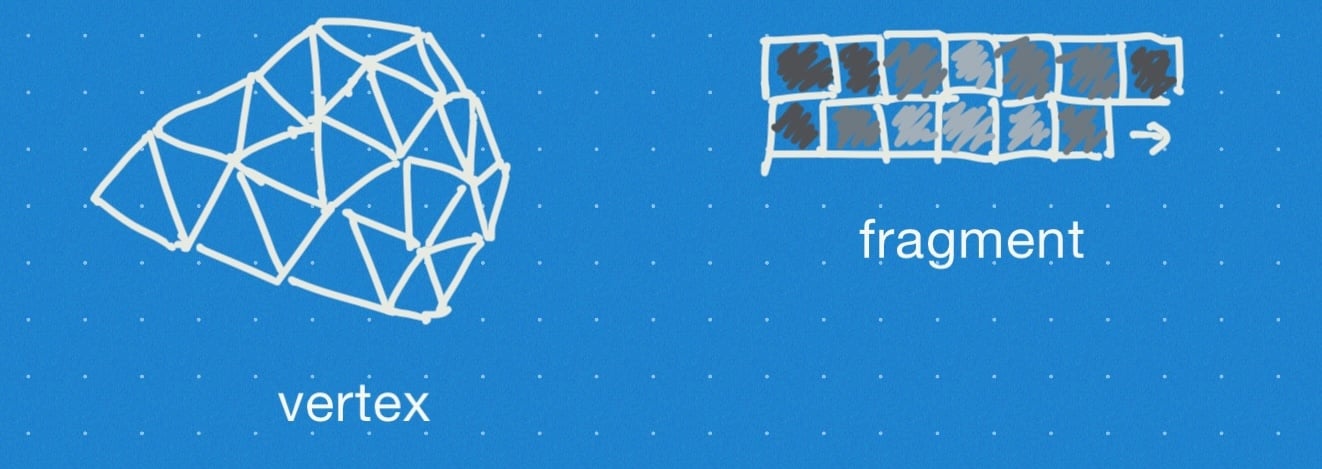
Over time, these fixed features were replaced by "shaders". The vertex shader would handle the overall structure with matrix multiply, clipping, fog, colors. Once we could control it, people came up with cloth, grass, water, terrain, animation, procedural geometry, and lots of other things. The fragment shader would handle fine details with texture lookup and lighting. Once we could control it, people came up with custom lighting, organic textures, animation, procedural art, and lots of other things.
Labels: speculation, structure
3D Printer Printers #
We have 3D printers that can take a description and print an object. Some 3D printers are capable of printing everything needed to make another 3D printer.

This reminds me of programming language implementations.
An interpreter takes a description (a program) and prints some output. A meta-circular interpreter is an interpreter written in the same language that it inteprets.

With programming languages we also have compilers that translate a program into another program that does the same thing but better (smaller and faster).

What's the equivalent for 3D printers? I think it'd be a 3D printer that prints another, more specialized printer. That specialized printer might work faster or produce higher quality output or work with materials that a general-purpose 3D printer can't work with.

The analogy isn't perfect but I'd like to see 3D printers that print more specialized printers.
Labels: speculation, structure
Scented sweat #
Many or perhaps all of the smells produced by your body are produced by the bacterial ecosystems living on and in you. Some of these smells are things we can detect; others we're unaware of. Certain strains of skin bacteria attract mosquitos. By altering the ecosystem on our skin, we can repel mosquitos. Cool!
With genetic engineering, we can do even more. We can replace the bacteria that turn sweat into unpleasant smells with bacteria that turn sweat into floral scents! No more deodorant!
Labels: future, speculation
Future tattoos #
Today's tattoos are boring. Future tech will bring:
- Bioluminescent tattoos: using bioluminescent chemicals, your tattoos will glow or pulse, either all the time, or synchronized with a clock, or triggered by movement or light or sound. Imagine going to a dance club with this.
- E-ink tattoos: with e-ink particles embedded in your skin, you'll be able to change the pattern by applying an external array of electric fields. You'll place the “printer” on your arm, apply a new pattern, and then it'll hold that pattern until you want to change it.
- Biosensor tattoos: with e-ink particles attached to a layer of biosensor molecules, you'll be able to find out what's going on in your blood. You'll set up blocks that are sensitive to 50, 100, 150, 200 mg/dL of glucose, and then by seeing how many bars are “lit up”, you'll have a rough estimate of your blood sugar. You could do this for everything in your bloodstream.
Cool? or creepy?
Labels: future, speculation
Bladder control #
I know there are lots of advanced technologies being developed for treating disease, but the same technologies could be used for non-disease applications. I wrote a little about this a few years ago. So I want to propose something that I think a lot of people would like:
Extra bladders
There are people working on 3d printed organs. Wouldn't it be cool to get a 3d printed bladder? Would you like to super-size that?
Even better, wouldn't it be cool if your supplemental bladder automatically ran tests on your urine, like these Japanese toilets do? The toilets developed in 2004 can measure glucose levels but I'm sure there are other tests that will be practical too. Plus, if it's done in your 3d printed bladder, it can be transmitted to your smartphone in real time over low energy bluetooth, like a Fitbit.
I'd want one. Wouldn't you?
Labels: future, speculation
Genetically engineered gut bacteria #
We're starting to learn how important gut bacteria are. Antibiotics can mess up the ecosystem in your gut. We have probiotics to try to restore the natural ecosystem.
(photo from worldworldworld on flickr)

This is assuming that natural is good. But the natural gut bacteria are evolved to match our natural diet. Most of us don't eat a natural diet.
I want unnatural gut bacteria.
We know cells can do amazing things. The cells in our body can turn fat and sugar into energy. Bacterial cells can do a far great variety of things, such as turning algae into oil, collecting gold atoms into gold veins, generate light, and process heavy metals. So let's design our own gut bacteria! I want to implant gut bacteria that turn chocolate cake into vitamins. I want gut bacteria to turn potato chips into omega 3.
Most people are drawn towards unhealthy food. We keep telling them to stop eating it, and eat healthy food instead. What if we could instead turn all unhealthy food into healthy food? (Also see my previous post on this subject.) I think that's a world-changing technology waiting to happen.
Update: [2024-03-22] Over ten years after I posted this, I see Monch Monch and Zya look interesting. They aren't gut bacteria but they do go into the gut to turn chocolate cake into fiber. Update [2025-04-14] Jason C points out that proteins require nitrogen, and carbs don't have any. So there could be some limitations to which molecules can be turned into which other molecules. Fiber may be a better output than protein. [2025-12-07] Someone has developed a genetically engineered gut bacteria to reduce kidney stones.
Labels: future, health, speculation
TiVo Features I want #
Over the years Tivo has added lots of features to the product. Unfortunately I'm not interested in most of them. Things I don't care about:
- Swivel Search
- Guru Guides
- podcasts
- Discovery Bar
- KidZone
- radio stations
- games
- TivoCast
- Photo, music, video streaming from my computer
I do like the internet guide loading (so I don't need a phone line), the Netflix/Hulu/Amazon streaming, and support for HDTV (Cablecard).
What I'd really like are features without funny names:
- When I press a button on the remote, the Tivo should react instantly.
- No more waiting. When I change a season pass or settings, I shouldn't have to wait for the Tivo to do its calculations. It should let me continue while it works in the background.
- When I delete several shows in a row from a folder, the Tivo shouldn't get confused. I sometimes find that it tells me the group is now empty, and I have to go out and back into the group to see the remaining shows.
- When I add a show to be recorded (or a season pass), I want to choose a folder. I don't want to use the folders by show name; I want to choose folders that mean something to me, like “history shows” or “time travel movies”. This didn't matter when the capacity was 40GB but the more storage there is, the more useful folders become.
- Instead of assuming I receive all 500 channels, ask me which level of Cable TV I subscribe to, so that I can see just the 100 channels I actually get. Every channel change can be relative to that list. Right now, most channel changes are irrelevant to me, and end up adding channels that I don't actually get.
I suspect that as a company gets larger, it's easier to get management to approve people working on features with names than on features without names. However, this is pure speculation on my part.
Labels: review, speculation
Gene therapy #
In an alternative universe, instead of hearing about gene therapy for:
- Cancer
- Alzheimer's
- Parkinson's
we'd be hearing about gene therapy for:
- Hair loss
- Hair color
- Hair style
- Eye color
- Skin color
- Perfume
- Effects of aging
- Weight loss and gain
- Muscle growth
- Body part enhancement
- Chicken that tastes like bacon
For the yellow outfit you're wearing today you might pick a light brown skin tone and green eyes. You'd use the light brown skin tone body wash to change the genes in your skin. You'd put in the green eye eyedrops to deliver the genes into your eyes. You'd place a stencil on your skin and use a spray to deliver genes for a light skin color tone to form a tattoo. You'd deliver citrusy scent genes to the odor-creating bacteria on your skin to produce that smell today.
But we don't live in that alternate universe. Instead of all these miracles, all we're going to get is a cure for cancer.
Labels: future, speculation
Evolutionary handicaps #
We evolved alongside parasites that weaken us, and recently in human history we were able to get rid of those parasites. What would happen? Our bodies would overcompensate, just like the “floating arms” experiment.
- If parasites weakened the immune system, then human bodies would adapt by making the immune system more aggressive. Removing the parasites would lead to human immune systems increasingly overreacting to things. There are some people who infect themselves with parasites to treat allergies and immune disorders.
- If parasites increased our aggressiveness (as toxoplasma gondii is hypothesized to do), then humans would adapt by lowering aggressivness. Removing the parasites would lead to more the human race becoming more passive.
- If parasites weakened our mental abilities, then humans would adapt by making extra-powerful brains. Removing the parasites would lead to more intelligent humans.
Is it possible that human brains are far more powerful than they need to be for survival in the wild because parasite evolution forced them to be that way?
Labels: speculation
Cows are like Poodles #
Poodles are man-made creatures. There were no packs of wild poodles roaming the African savannah, hunting antelope. Poodles were created by humans, through breeding, over thousands of years. They act and look very different from wolves because we bred them for appearance retrieving and, recently, appearance (edit: corrected, thanks to Simon Proctor's comment below). That's where we focused our energies, and it shows.
photo by jonner on flickr

Cows are also man-made creatures. Let me clarify: the cows we milk and eat are man-made creatures. We've created them through breeding, over ten thousand years. They look similar to wild cattle (now extinct) because we bred them for what's on the inside. We've made them smaller and more docile. We've made them produce more milk. We've made them produce more meat. We've also altered their appearance, but not as much as we've done for poodles. There were no herds of black-and-white mottled cows roaming across Asia.
photo by hockadilly on flickr

So that's my random thought for the day: cows are like poodles. They're man-made creatures.
Labels: speculation
Future anti-predictions 2 #
I'm quite optimistic about the future, but I seem to be posting anti-predictions instead of predictions. Perhaps I'll post positive predictions someday, but today I have some more negative ones:
Labels: future, speculation
Future anti-predictions #
Perhaps I'm just tired of waiting for my flying car or hoverboard, but I'm not so optimistic that we'll see certain technologies become popular.
- Cars that drive themselves. There's lots of research and good arguments about safety and efficiency and congestion. There are already commercial products for parallel parking, distance-controlled cruise control, and lane detection. But I think the real problem is liability. If there's an accident with a car you drive, it's a local problem (you). If a big company's car crashes while driving automatically, there's the potential for a very large lawsuit. Society benefits from automated driving but these companies pay for it. Early adopter individuals don't benefit enough that the companies can charge more. Such an arrangement makes it much less likely that these systems will leave the research phase. I also think congestion is much more likely to be addressed by variable pricing and better information than by automated driving.
- 3D displays. There's been a recent increase in 3D TV, movies, and video games, but most of the technology doesn't seem any better than the last time 3D flared up in popularity. The image in your eye is inherently 2 dimensional. If it were 3 dimensional you'd be able to see behind and inside things (Flatland is an interesting read if you want to understand this better). To see 3D in your brain you need to have separate images in the left and right eye. You can do this with glasses: color filters (red/blue, used for TV), circular polarized light filters (used in movie theaters), or timed shutters (used in video games). Or you can do this without glasses, by using the difference in viewing angle between the eyes (Philips WowVX for example), but this requires either a single viewer or all viewers to be roughly the same distance from the display. You can also produce 3D effects at a different level of the brain, by viewing different angles (either statically with animation or dynamically with head tracking). The problem is that all of these systems have limitations that exceed the marginal benefit of 3D, once the novelty wears off. So they'll all be used in specialized situations like medical imagery, advertising in malls, and a small number of TV/movie/game applications. But I think 3D displays are not going to be widespread.
- Humanoid robots. Humans are better than computers at some things: creativity, language, pattern recognition, art, design, reasoning. Computers are better than humans at some things: calculations, memorization, repetitive motion, fast sensors. People seem to think that the future is about making robots that look and work like us, but there's no point. We have plenty of humans. We will build robots that do the things we're not good at. And that means there's no particular reason to use a humanoid form. The future of robots is not humanoid. I think humans with machine parts will become commonplace, but they won't be robots replacing or competing with us; they'll be enhancing us.
In general though I'm quite optimistic about the future. I just think the things that actually succeed won't be the commonplace predictions you see in movies and TV.
Labels: future, speculation
The future of food #
Imagine a world in which the way food tastes and the nutrition are independent. You could eat vitamin-fortified soylent green and make it taste like pizza or bacon or ice cream or chocolate cake. It's just like those dreams programming language people have of having surface syntax independent of the parse tree, so that you can have many different syntaxes on the same program. It's like those movies where the evil villain wears pink.
In the future, what you see, smell, taste, feel, and hear doesn't have to match what's on the inside.
Bacon Salt is one of the early pioneers in this future of food. I hope to see many more.
Labels: future, speculation