Fractal islands in the Pacific #
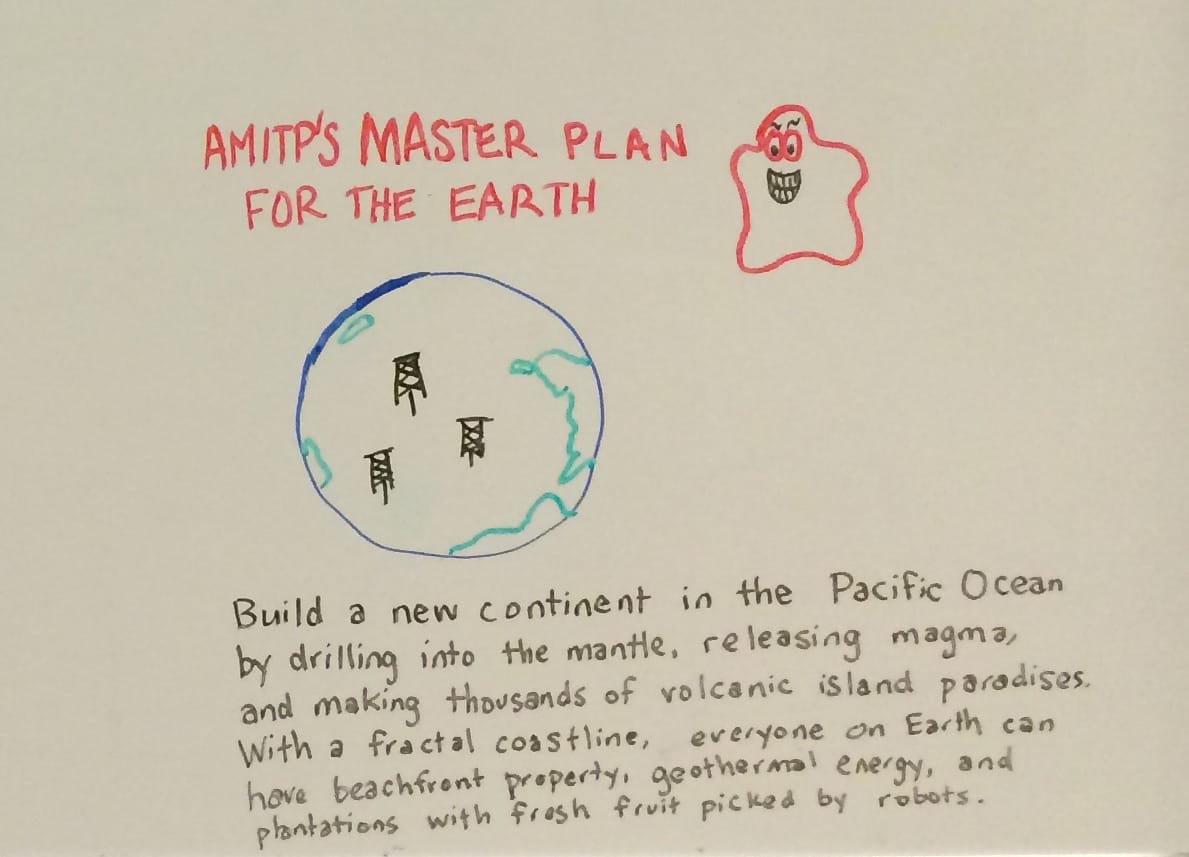
I'm not a big fan of the Pacific Ocean. There. I said it. I like water/land interfaces. Coasts, rivers, lakeshores, beaches, coral reefs, tide pools. The Pacific Ocean has too few of these. So … let's fix it. Here's an idea I had from around 2003 but never blogged about:
Labels: future
iTunes Sync Error -256 #
This was a mystery.
I had been messing with my photo sync settings in iTunes, so that I could get more photos onto my iPhone. I started getting this iTunes sync error, -256. I googled for this but naturally Google ignored "256", as it seems to enjoy ignoring the most important words in my queries. I couldn't find an answer, and I had no luck deleting and resyncing photos. I decided I should wipe the phone and restore from backup at some point, but "not today".
A few weeks later (today) I discovered the real culprit. At some point in the past few months I had accidentally deleted podcast files in iTunes. I had restored the iTunes catalog file, and I had restored the files themselves from Trash. Or so I thought. I discovered today that I hadn't gotten them all. Once I fixed that (by deleting in iTunes and telling it to download them again), the photo sync worked again!
Grr1: iTunes does too many things, and it's hard to diagnose errors. Grr2: "error -256" is unhelpful. If it told me what it was doing at the time, it would've helped me realize it was podcasts and not photos that were the problem. Grr3: iTunes catalog and the files on disk can get out of sync; this is fragile.
I'm writing this blog post so that if anyone else has error -256, and convinces Google not to ignore that term, they might find a solution here.
Labels: mac
Heat needed to melt ice #
I knew that melting ice takes heat, but didn't have a good sense for how much. I decided to calculate it.
- Specific heat tells you how much heat it takes to increase temperature. For water, it's around 4.2 joules per gram of water to raise the temperature by +1°C.
- Latent heat (of fusion) tells you how much heat it takes to turn solid into liquid, while not changing temperature. For ice→water, it's 334 joules per gram of water.
So we have two different processes: water to hotter water, and ice to water. How do they compare? Let's divide 334 J/g/°C ÷ 4.2 J/g = 79.5 °C.
That means the same amount of heat can do either:
- Melt ice.
- Raise water temperature by 79.5°C (143°F).
Yow!
That's much higher than I expected. Did I do the calculation wrong? I checked specific heat and latent heat again, but I can't see anything wrong with the calculation.
Now imagine what happens with climate change. If you add heat to a system, and there's ice around, it will melt the ice. But if there's no ice around, that same amount of heat will increase the temperature by 79.5°C (143°F). eeek!!
(please tell me I did the calculation wrong, because those numbers are scary)
Labels: environment
Emacs Org mode and KaTeX #
Emacs Org mode can handle LaTeX math, and exports it to HTML using MathJax. On my pages I have been using KaTeX instead of MathJax. It loads faster but doesn't support as many features. Org mode doesn't have direct support for KaTeX but for the simple things I do on my pages, I can redirect MathJax to KaTeX using KaTeX autorender:
(setq org-html-mathjax-template
"<link rel=\"stylesheet\" href=\"https://cdn.jsdelivr.net/npm/katex@0.10.0/dist/katex.min.css\" integrity=\"sha384-9eLZqc9ds8eNjO3TmqPeYcDj8n+Qfa4nuSiGYa6DjLNcv9BtN69ZIulL9+8CqC9Y\" crossorigin=\"anonymous\"/>
<script defer=\"defer\" src=\"https://cdn.jsdelivr.net/npm/katex@0.10.0/dist/katex.min.js\" integrity=\"sha384-K3vbOmF2BtaVai+Qk37uypf7VrgBubhQreNQe9aGsz9lB63dIFiQVlJbr92dw2Lx\" crossorigin=\"anonymous\"></script>
<script defer=\"defer\" src=\"https://cdn.jsdelivr.net/npm/katex@0.10.0/dist/contrib/auto-render.min.js\" integrity=\"sha384-kmZOZB5ObwgQnS/DuDg6TScgOiWWBiVt0plIRkZCmE6rDZGrEOQeHM5PcHi+nyqe\" crossorigin=\"anonymous\" onload=\"renderMathInElement(document.body);\"></script>")
(it looks ugly but it's straight from the KaTeX autorender page, but with quotes backslashed)
This seems to work on the small tests I've done so far.
Emacs: prettier tabbar #
Back in 2007 I posted that I was going to try buffer tabs for Emacs. At the time I wasn't sure if I'd like it. People told me that there's no point in displaying them visually like in other editors, that Emacs had better ways of switching buffers. I ended up abandoning Tab Bar mode. But some time later, I started using it again, and I found the new version worked really well for my needs.
This post is mostly about the visual customization I use. I make the current tab blue, the other tabs gray, and the background dark gray. I use powerline to make the tabs look more like tabs:
